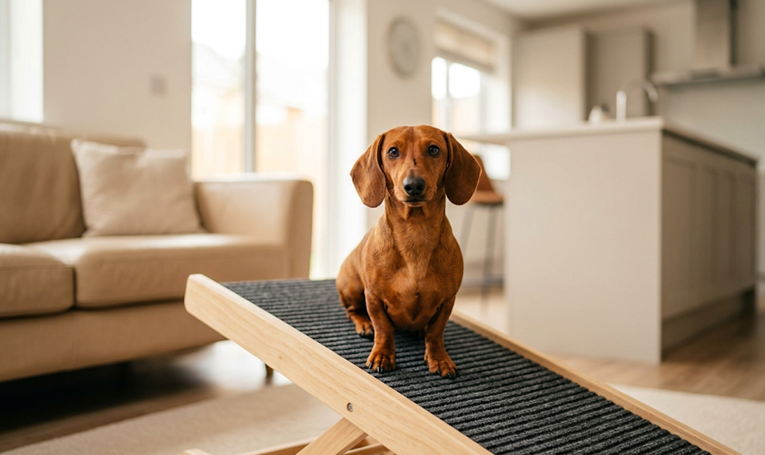
The "Hardware" Misunderstanding
If you're tired of watching your Dachshund treat their ramp like a tactical nap spot... it's not a training problem—it's hardware.
💡 Pro-Tips for Quick Wins
-
The "Treat Trail": Don’t just give a treat at the top. Line the ramp with tiny pieces of high-value bait (chicken or liver) to create a "path of least resistance."
-
The "Wall Trick": Move the ramp flush against a wall so they only have one "open" side, reducing the temptation to bail sideways.
-
The Traction Hack: If the ramp feels "slippery" to them, lay a non-slip yoga mat or a piece of high-grip ribbed carpet over the surface.
-
The "No-Jump" Barrier: Use cushions or a temporary physical barrier to block their favorite "illegal" jump zones (like the armrest) until the ramp becomes their default route.
Still looking for the right gear? Check out our Top Gear Guide 2026 including the ramps with the best grip and safety ratings.
🧠 The Science: Why Ramps are "Scary"
Many owners think their dog is being "naughty," but usually, it’s a hardware issue. Dachshunds have a unique center of gravity that makes ramps feel like mountains.
-
The Depth Perception Gap: To a dog only 9 inches off the ground, a steep ramp looks like a cliff edge.
-
The "Wobble" Factor: If a ramp has even 1mm of lateral wobble, a Dachshund’s internal equilibrium will red-flag it as unsafe. They prefer the "solid" feel of a jump over a "shaky" climb.
-
Muscle Memory: If they spent their first 2 years jumping, their leg muscles are conditioned for explosive movement. They literally have to "re-learn" how to engage their core for a slow, steady climb.
📊 Technical Checklist: Is Your Gear the Problem?
Use this table to audit your current setup before giving up on training.
| Feature | The "Danger" Zone | The "Smart Pet" Standard |
| Incline Angle | Over 35° (too steep) | 20° to 25° (gentle slope) |
| Surface Grip | Smooth carpet or plastic | High-traction ribbed carpet |
| Width | Under 30cm (causes anxiety) | 35cm - 45cm (room for error) |
| Side Rails | None | Raised edges for security |
🚀 The 3-Step "Ramp Reboot" Protocol
If the basic tips failed, it’s time for the advanced "Channeling" strategy.
Phase 1: The Physical Blockade 🧱
Stop negotiating. Use your sofa cushions to create a "V-shaped funnel" leading onto the ramp. If they cannot physically touch the armrest, the ramp becomes the only path.
Rule #1: The blockade stays up for 14 days. Consistency is the only way to rewrite their brain.
Phase 2: The "Up Only" Rule ⬆️
Descending is 3x harder on the spine than ascending. For the first week, only enforce the ramp for going UP. Use a harness to gently guide them. Once they realize the ramp is the "easy way up," they will choose it for the way down.
Phase 3: Surface Familiarization 🍽️
Take the ramp away from the sofa. Lay it flat on the kitchen floor and let your dog eat their dinner on it. If they associate the texture of the ramp with "food and safety" rather than "scary climbing," the battle is 80% won.
🛑 A Note on IVDD Prevention 🩺
Intervertebral Disc Disease (IVDD) isn't just about one "bad jump." It’s about cumulative micro-trauma. Every time a Dachshund lands, their spine absorbs an impact force roughly 3x - 5x their body weight. By reducing jumps by even 50%, you are significantly extending their mobility years.